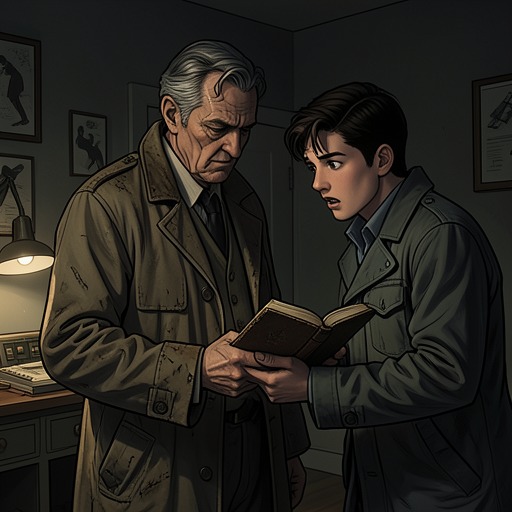
Martha Padgett—Dan Padgett
The LighthouseMartha Padgett’s relationship with Dan Padgett turns on a hidden paternity that Martha disclosed only near the end of her life. Her hope that Dan might know his father—and perhaps be acknowledged by him—helps set in motion the chain of events leading to two violent deaths. The relationship is therefore both intimate and painfully indirect: a mother’s long silence shapes her son’s life, while her final effort to change that silence arrives too late to repair what it has done.
Identity and the concealed paternity
Before she died, Martha Padgett confided to Adrian Boyde that Dan Padgett was Nathan Oliver’s son. She had chosen someone she could trust, and the confidence was protected by the seal of the confessional: Martha and Mrs. Burbridge regarded Adrian Boyde as a priest to whom a secret could be entrusted. That protection also constrained what Adrian Boyde could tell the police after he began to suspect Dan Padgett.
The available evidence does not establish every step of Martha Padgett’s eventual disclosure to her son. The investigation reasons that Adrian Boyde must have persuaded her that Dan Padgett had a right to know, and that she—not the confessor—had to tell him. By the time Dan Padgett confronted Nathan Oliver, he knew enough about his parentage to demand that the truth be faced.
A final journey to Combe Island
Martha Padgett and Dan Padgett arrived on Combe Island in June 2003. Their visit followed Nathan Oliver’s widely reported April interview, in which he said he made regular visits to the island, breaking the Trust’s confidentiality agreement. The timing raises the possibility that Martha Padgett hoped the public disclosure of his whereabouts would allow her son and his father to meet, and that some relationship might still develop. She may also have hoped Nathan Oliver would acknowledge Dan Padgett as his son.
The account presents these hopes as possibilities rather than certainties. It also connects Martha Padgett’s late urgency to two facts that could have altered her sense of what was possible: DNA testing was not available when Dan Padgett was born, and she later understood that she was dying. The delay had left the truth unspoken through much of their lives; her final journey brought it close to disclosure, but could not ensure reconciliation.
The cost of silence
The investigation imagines that Martha Padgett may have kept and reread one of Nathan Oliver’s books because it described a seduction, perhaps even a rape. That possibility is not established as fact, but it gives the hidden paternity a darker dimension: Martha Padgett may have carried not only a secret but an unresolved history of violation. The account also considers whether Nathan Oliver had refused to acknowledge the child and whether, in the absence of DNA testing, Martha Padgett believed she could not prove his paternity.
Dan Padgett’s childhood is recalled as one of deprivation and humiliation. The later reconstruction pictures his mother as penniless and homeless, dependent on an unloving aunt, while he was treated as a charity child and moved through failed jobs. This imagined history helps explain the weight the concealed identity carried for him, without making his later violence inevitable: the narrative explicitly rejects the idea that every illegitimate, ill-treated, or unwanted child becomes a killer.
Consequences and significance
Martha Padgett’s secret becomes a turning point in the case. Her death and Dan Padgett’s apparent loss of a blood sample initially seem unrelated to Nathan Oliver’s murder; the investigation eventually recognizes both as central. The sample had never been in the bag, and the object Dan Padgett let fall into the sea was merely old shoes, handbags, and library books. The concealed parentage, rather than the supposed loss of evidence, connects the mother’s final months to her son’s confrontation with Nathan Oliver.
Martha Padgett’s hope that father and son might meet thus stands in stark contrast to the outcome: knowledge of the relationship does not produce reconciliation. Instead, the secret helps precipitate Nathan Oliver’s murder and, after Adrian Boyde’s attempt to intervene, another death. Martha Padgett’s late effort to alter her son’s inheritance of silence becomes part of the tragedy that her silence had helped prepare.